A New, Minimally Invasive Option for SI Joint Pain
By Dr. John Dombrowski, Washington Pain Center
If you have a deep, nagging ache in one side of your buttock that wraps into your hip and sometimes pulls into your groin, there's a reasonable chance the problem isn't your spine at all. It may be your sacroiliac joint — and it's one of the most commonly overlooked sources of chronic low back and pelvic pain.
I recently recorded a short video walking through a newer approach to treating it. Here's the written version.
Where the SI joint is, and why it hurts
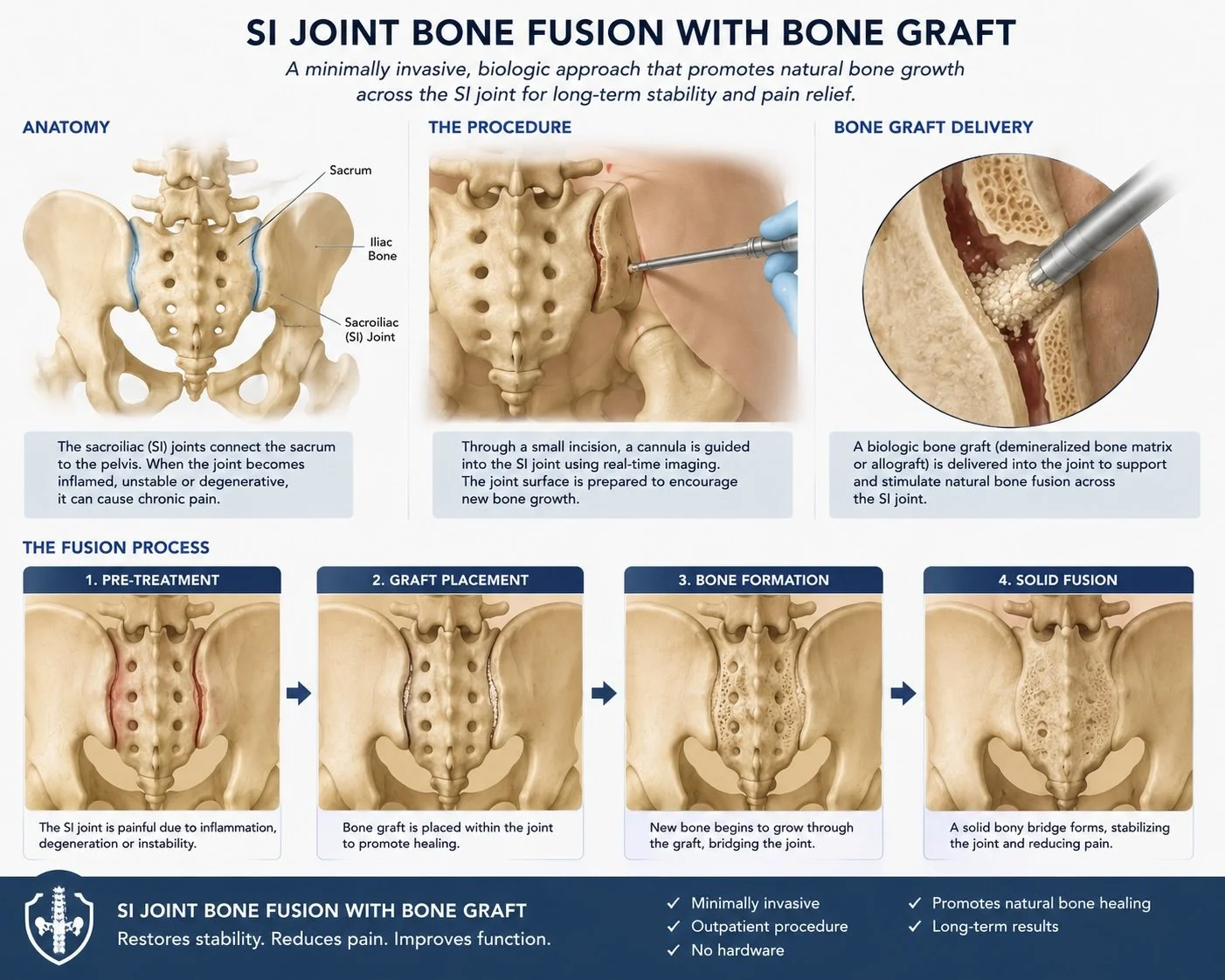
Your sacrum is the triangular bone at the base of your spine — what most people call the tailbone. On either side of it sits the ilium, the large wing-shaped pelvic bone whose upper ridge, the iliac crest, is where your belt rides. Where the sacrum meets the ilium, you have a joint: the sacroiliac, or SI, joint.
It's a joint that isn't built to move much. It's built to transfer load between your spine and your legs. When it becomes irritated, degenerated, or unstable, it produces a very characteristic pattern of pain:
Deep, one-sided pain in the buttock
Pain referring into the hip and outer thigh
Pain that pulls into the groin
A general ache across the "pelvic bowl"
Worse with sitting, standing up, stairs, or rolling over in bed
Because that pattern overlaps so heavily with sciatica and hip arthritis, SI joint pain is frequently misdiagnosed — and patients often spend years being treated for the wrong thing.
Why it often shows up after a spinal fusion
This is the part I want patients and their families to understand, because it explains so many cases we see.
When a segment of the lumbar spine is fused, that segment stops moving. But the load still has to go somewhere. The joints above and below the fusion absorb more of it than they used to — and the SI joint sits directly below. Over time, that extra demand can wear on it.
So a patient whose back surgery genuinely worked can still develop a new, different pain a few years later. That's not a failed fusion. It's a different joint asking for attention.
SI joint pain also develops from ordinary degeneration and aging, from trauma such as a fall or car accident, from pregnancy and childbirth, and from inflammatory arthritis.
What we've been able to offer — and where it falls short
As an anesthesiologist and interventional pain physician, my toolkit for the SI joint has historically looked like this:
Diagnostic and therapeutic injections. We place numbing medication and often a steroid directly into or around the joint under X-ray guidance. These are genuinely valuable — both because they can relieve pain and because a good response helps confirm the SI joint is actually the pain generator.
Radiofrequency ablation (RFA). Here we use heat to interrupt the small nerves carrying pain signals from the joint. It can work well and can last considerably longer than an injection.
Both are effective tools, and for many patients they're enough. But they share a limitation: neither one changes the joint itself. Nerves regenerate. Inflammation returns. If the underlying issue is a joint that's degenerated or moving in a way it shouldn't, we're managing the signal rather than addressing the structure. For some patients that means coming back for repeat procedures indefinitely.
What's changed: fusion through a needle-sized opening
Fusing the SI joint isn't a new idea. Orthopedic surgeons have done it for years by placing screws across the joint to lock the sacrum and ilium together. It works — but it's a substantial operation, with a meaningful recovery and a real complication profile.
The newer approach is dramatically smaller. Instead of screws, we place small bone allograft implants — donated human bone — directly into the joint space, where they act as a scaffold for your own bone to grow across and fuse the joint naturally.
Here's how the procedure goes:
A tiny incision. The channel we create is roughly the diameter of a large needle — in the range of a 14 to 16 gauge. In the video I hold the implant up next to my fingernail for scale.
Anesthesia to fit the patient. It can be done under local anesthesia, or in the operating room with IV sedation, depending on the case and your preference.
Placement under live X-ray. A delivery instrument is guided into the joint space under fluoroscopy, so we can see exactly where the implant is going in real time.
Deployment. The implant is advanced through the instrument and set into position. Typically two implants are placed.
Home the same day. This is an outpatient procedure — in and out.
On the post-procedure X-ray, you can see the implants sitting neatly in the joint space between the sacrum and the ilium. Over the following months, bone grows into and around them.
Who is a candidate?
Not everyone with buttock or hip pain — and that matters. A responsible workup generally includes:
A physical exam with provocative maneuvers specific to the SI joint
Imaging to rule out other sources
One or more diagnostic injections confirming the SI joint is the pain generator
A documented trial of conservative care — physical therapy, medication, injections
That last piece isn't just box-checking for insurance. If a joint injection doesn't temporarily relieve your pain, fusing that joint is unlikely to be the answer either. The workup protects you from an unnecessary procedure.
The bottom line
If you have deep one-sided buttock, hip, or groin pain — especially if it started or worsened after a lumbar fusion, and especially if injections help but never last — the SI joint deserves to be part of the conversation.
It's a meaningfully smaller procedure than what was available a decade ago, and it's aimed at the structure rather than just the signal.
Think this might describe your pain? The Washington Pain Center offers comprehensive evaluation and treatment for sacroiliac joint pain in Washington, DC. Call (202) 883-8001 or request an appointment online.
This article is for general educational purposes only and does not constitute medical advice or create a physician-patient relationship. Individual results vary, and not all patients are candidates for SI joint fusion. Candidacy can only be determined through in-person evaluation. Please consult a qualified physician regarding your specific condition.
FAQ
Is SI joint fusion painful? The procedure is performed under local anesthesia or IV sedation, so you should not feel pain during it. Some soreness at the site afterward is normal and typically manageable.
How long does the procedure take? It is performed as a same-day outpatient procedure. Most patients go home the same day.
How is this different from the older screw procedure? Traditional SI fusion uses screws placed across the joint through a larger surgical exposure. This approach uses small bone allograft implants placed through an opening roughly the size of a large needle, under X-ray guidance.
Will insurance cover SI joint fusion? Coverage varies by plan and generally requires documentation of failed conservative treatment and a positive diagnostic injection. Our office can help verify your benefits.
How do I know my pain is coming from the SI joint? Diagnostic injections are the most reliable way to confirm it. If numbing the joint temporarily relieves your pain, that's strong evidence the SI joint is the source.
Suggested internal links: your existing pages on radiofrequency ablation, SI joint injections, and post-laminectomy/failed back surgery syndrome.